Je bent je ingevulde velden bij deze pagina aan het verwijderen. Ben je zeker dat je dit wilt doen?
You are erasing your filled-in fields on this page. Are you sure that is what you want?
Nieuwe Versie BeschikbaarNew Version Available
Er is een update van deze pagina. Als je update naar de meest recente versie, verlies je mogelijk je huidige antwoorden voor deze pagina. Hoe wil je verdergaan ?
There is an updated version of this page. If you update to the most recent version, then your current progress on this page will be erased. Regardless, your record of completion will remain. How would you like to proceed?
Given two vectors \(\vec {u}\) and \(\vec {v}\), let \(\theta \) be the angle between them such that \(0\leq \theta \leq \pi \). We will refer to \(\theta \) as the included angle.
The following theorem establishes a relationship between the dot product and the included angle.
Let \(\vec {u}\) and \(\vec {v}\) be vectors in \(\RR ^n\), and let \(\theta \) be the included angle. Then
Let \(\vec {u}\) and \(\vec {v}\) be vectors in \(\RR ^n\). We say \(\vec {u}\) and \(\vec {v}\) are orthogonal if \(\vec {u}\dotp \vec {v}=0\).
We can use Theorem 1 to show that two non-zero orthogonal vectors of \(\RR ^n\) are simply perpendicular vectors (the included angle
is \(90^{\circ }\)). To see this, suppose that \(\vec {u}\dotp \vec {v}=0\) for nonzero vectors \(\vec {u},\vec {v}\). Then from Theorem 1 we have
Since \(\vec {u},\vec {v}\) are nonzero vectors, we have \(0=\cos \theta \), which implies \(\theta =90^{\circ }\). The converse also holds. If \(\theta =90^{\circ }\), then the dot product is clearly
0.
The reason we prefer the term “orthogonal" to “perpendicular" in this course is because \(\RR ^n\) is only one example of a vector
space, and the dot product is only one example of a more general product, called an inner product. For vectors in \(\RR ^n\) a zero dot
product happens to coincide with the geometric idea of perpendicularity, but there are many vector spaces that do not
possess the visual geometry of \(\RR ^n\). (Later in the text, you will encounter vector spaces whose vectors are polynomial functions!)
In these more abstract settings, a zero inner product still signals a special relationship between vectors. The term orthogonal
captures this relationship.
By our definition, the zero vector is orthogonal to any vector. However, we will not use the word perpendicular when the zero
vector is involved, as it is not possible to talk about an “included angle”.
Practice Problems
Find the degree measure of the included angle, \(\theta \) for each pair of vectors. Round your answers to the nearest
tenth.
1.
\(\begin{bmatrix}1\\2\end{bmatrix}\) and \(\begin{bmatrix}-3\\-1\end{bmatrix}\).
Answer: \(\theta =\answer {135}^\circ \)
2.
\(\begin{bmatrix}-1\\2\\4\end{bmatrix}\) and \(\begin{bmatrix}-2\\1\\-1\end{bmatrix}\)
Answer: \(\theta =\answer {90}^\circ \)
3.
\(\begin{bmatrix}0\\-3\\1\end{bmatrix}\) and \(\begin{bmatrix}-5\\-2\\4\end{bmatrix}\)
What does the sign of the dot product tell us about the included angle?
Find all values of \(a\) so that \(\begin{bmatrix}a^2\\2a\\1\end{bmatrix}\) is orthogonal to \(\begin{bmatrix}1\\2\\3\end{bmatrix}\). List your answers in increasing order.
Answer: \(\answer {-3}, \answer {-1}\).
Find the value of \(x\) for which the vector \(\begin{bmatrix}x\\-4\end{bmatrix}\) is parallel to the vector \(\begin{bmatrix}3\\2\end{bmatrix}\). What is the measure of the included angle, \(\theta \)? Find the
measure of the included angle using Theorem 3. Do the two results agree?
Answer:
\[x=\answer {-6}\]
\[\theta =\answer {180}^\circ \]
Prove that if \(\vec {u}\) is a unit vector, then \(\vec {u}\dotp \vec {u}=1\).
Prove that if \(\vec {u}_1\) and \(\vec {u}_2\) are unit vectors, then \(-1\leq \vec {u}_1\dotp \vec {u}_2\leq 1\). In what cases are the extreme values of 1 and \(-1\) attained?
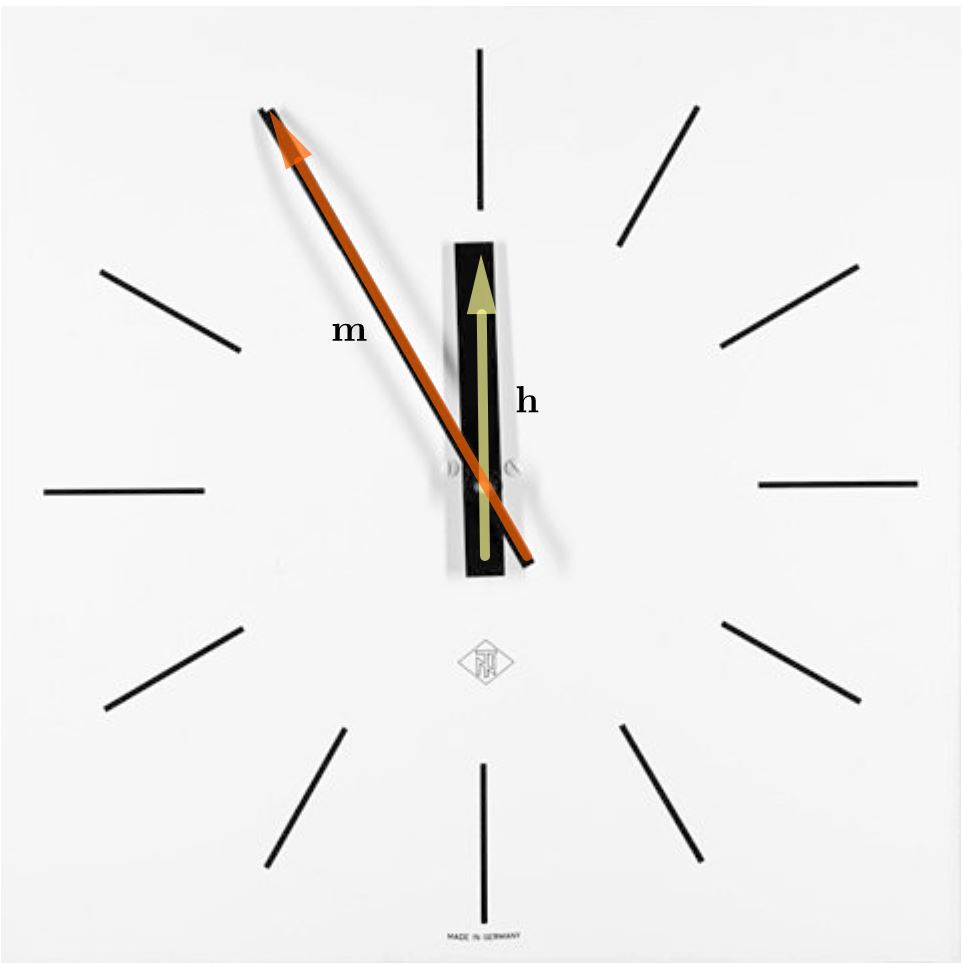
Imagine a clock with hands represented by vectors \(\vec {m}\) and \(\vec {h}\), as shown below. At what whole hour will \(\vec {m}\dotp \vec {h}\) attain its maximum
value? At what whole hour will \(\vec {m}\dotp \vec {h}\) be as small as possible?
Answer:
\[\vec {m}\dotp \vec {h}\text { is greatest at }\answer {12}:00 \text { o'clock}\]
\[\vec {m}\dotp \vec {h}\text { is smallest at }\answer {6}:00 \text { o'clock}\]
![[Picture]](main.online-d4cbc19d93fcb249e30c9f94f3919a65.svg)
![[Picture]](main.online-c11ba138265f55dcb886fd506d4317ae.svg)
 Week 1