Je bent je ingevulde velden bij deze pagina aan het verwijderen. Ben je zeker dat je dit wilt doen?
You are erasing your filled-in fields on this page. Are you sure that is what you want?
Nieuwe Versie BeschikbaarNew Version Available
Er is een update van deze pagina. Als je update naar de meest recente versie, verlies je mogelijk je huidige antwoorden voor deze pagina. Hoe wil je verdergaan ?
There is an updated version of this page. If you update to the most recent version, then your current progress on this page will be erased. Regardless, your record of completion will remain. How would you like to proceed?
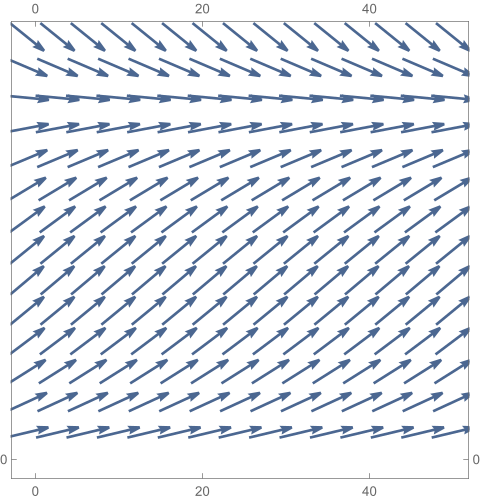
Determine which first order differential equation has this slope field. A direction field.Figure 1: A direction field (also known as a slope field)
(a)
\(y^{\,\prime }=xy\)
(b)
\(y^{\,\prime }=x^2y\)
(c)
\(y^{\,\prime }=xy^2\)
(d)
\(y^{\,\prime }=x^2y^2\)
(e)
\(y^{\,\prime }=x/y\)
(f)
\(y^{\,\prime }=y/x\)
(2)
Find a real value of the parameter \(k\) such that \(y=e^{kt}\) is a solution to \(y^{\,\prime \prime }-y^{\,\prime }-12y=0\).
(3)
A 1st order differential equation \(y'=f(t,y)\) with a so-called \(``\)initial condition" \(y(t_0)=y_0\) is called an
Initial Value Problem (abbreviated \(``\)IVP"). An \(``\)IVP solution" must satisfy both
the differential equation and the initial condition. There is a unique
solution \(y(t)\) to the 1st order IVP \(ty^{\,\prime }-y=-\dfrac {200}{t}\), \(y(1)=101\) on the interval \((0,\infty )\). Find \(y(2026)\) to the nearest
hundredth.
(4)
On which of the following open intervals is it guaranteed that there is NO
solution to the IVP \((x+1)y^{\,\prime }+y=1\), \(y(0)=2\)? Select all that apply.
(a)
\((-\infty ,\infty )\)
(b)
\((-1,1)\)
(c)
\((-1,\infty )\)
(d)
\((-\infty ,1)\)
(e)
\((-2,1)\)
(f)
\((-2,2)\)
(g)
\((-2,-1)\)
(h)
\((-1,2)\)
(5)
Suppose an epidemic spreading through a certain population is modeled by the
differential equation \(y^{\,\prime }(t)=ay(t)-b[y(t)]^2\) where \(a,b\) are positive constants and \(y(t)\) is the number of
individuals who have the disease at time \(t\) days. Below is a direction field for
such a model. Suppose we are given that \(a=0.75\) and \(\displaystyle \lim _{t\rightarrow \infty } y(t)=6,000\) for any non-trivial solution \(y(t)\).
Determine \(b\). Round to the nearest ten-thousandth. Figure 2: Another direction field
 Applied Differential Equations
![[Picture]](activity1.online-dc04767f3585715fdda8b6d633db636c.svg)