Je bent je ingevulde velden bij deze pagina aan het verwijderen. Ben je zeker dat je dit wilt doen?
You are erasing your filled-in fields on this page. Are you sure that is what you want?
Nieuwe Versie BeschikbaarNew Version Available
Er is een update van deze pagina. Als je update naar de meest recente versie, verlies je mogelijk je huidige antwoorden voor deze pagina. Hoe wil je verdergaan ?
There is an updated version of this page. If you update to the most recent version, then your current progress on this page will be erased. Regardless, your record of completion will remain. How would you like to proceed?
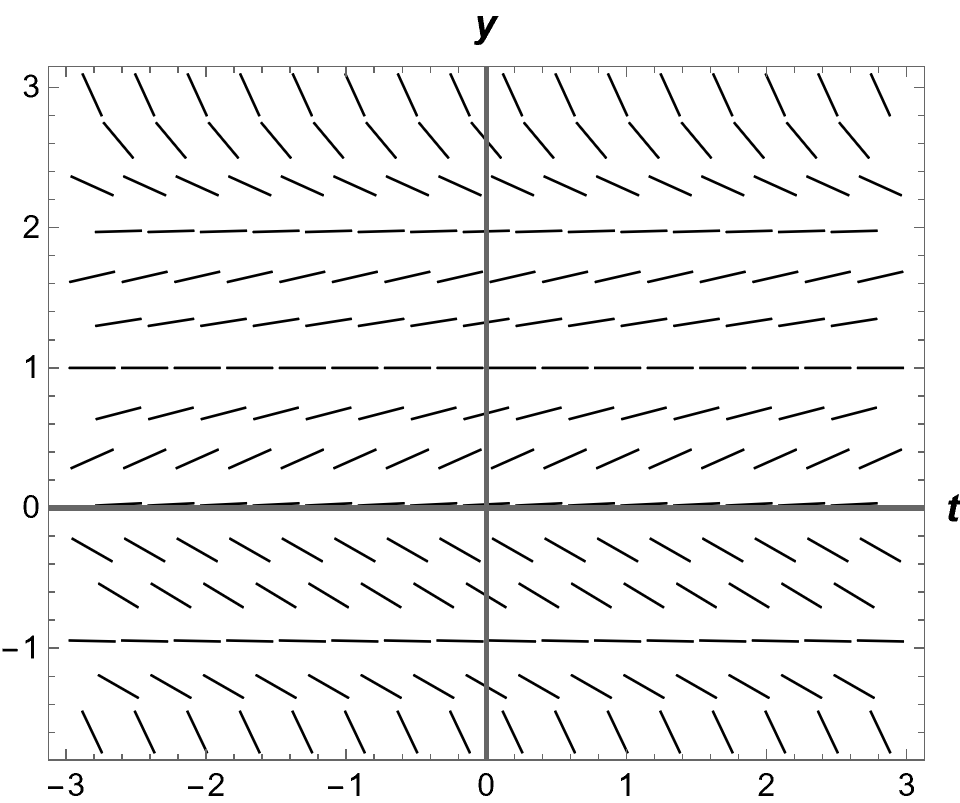
Let’s consider the first order autonomous differential equation \(y^{\,\prime }=\,-\,\dfrac {(y^2-2y)(y^2-1)^2}{\sqrt {1+y^8}}\) and part of its
(approximate) direction field below.
Figure 1: A direction field
(a)
Let’s determine all the equilibrium solutions.
(b)
Let’s classify each equilibrium solution as asymptotically stable,
semistable, or unstable.
(c)
Suppose \(y(t)\) is a solution to \(y^{\,\prime }=-\dfrac {(y^2-2y)(y^2-1)^2}{\sqrt {1+y^8}}\) satisfying that \(y(0)=0.5\). Let’s determine \(\displaystyle \lim _{t\rightarrow \infty } y(t)\).
(d)
Let’s determine the possible limits as \(t\rightarrow \infty \) for non-constant solutions to \(y^{\,\prime }=-\dfrac {(y^2-2y)(y^2-1)^2}{\sqrt {1+y^8}}\).
A second order autonomous equation is a differential equation of the form
\(y^{\,\prime \prime }=f(y,y^{\,\prime })\).
Let’s consider a special case: \(y^{\,\prime \prime }=f(y)\).
(a)
By multiplying both sides by \(y^{\,\prime }\) we get \(y^{\,\prime }y^{\,\prime \prime }=f(y)y^{\,\prime }\). Then we can integrate both sides
(with respect to the independent variable). Let’s determine what we get
when we do this, Using that \(y^{\,\prime \prime } \mathrm {d}t=\mathrm {d}(y^{\,\prime })\) and \(y^{\,\prime } \mathrm {d}t=\mathrm {d}y\). The result is a separable differential
equation.
(b)
Let’s solve the IVP \(y^3y^{\,\prime \prime }=-1\), \(y(1)=1\), \(y^{\,\prime }(1)=-1\) using this method.
 Applied Differential Equations