 Applied Differential Equations
- Verberg vooruitgang Hide progress Toon vooruitgang Show progress
- Verwijder je antwoorden (op deze pagina) Remove your answers (on this page)
Applied Differential EquationsThere are many applications of 2nd order differential equations, particularly 2nd
order linear. We take a look at a couple.
RLC Circuits: An RLC circuit is one that includes a voltage source of voltage \(V(t)\) (SI
units of volts) as a function of time, a resistor of resistance \(R>0\) (SI units ohms), a coiled
wire inductor of inductance \(L>0\) (SI units henries), and a plate capacitor of capacitance \(C>0\)
(SI units farads).
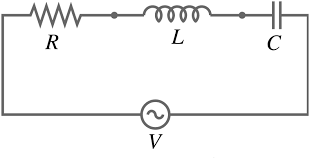
Let \(Q(t)\) be the charge (SI units of coulombs) on one plate of the capacitor at time \(t\). Then \(I(t)=\dfrac {dQ}{dt}\) is the electrical current (SI units of amps) in the circuit (flowing towards one plate if positive and the opposite direction if negative). From physics we have the following basic laws for the change in voltage across each circuit component:
Kirchhoff’s law that says that the voltage change across any two points has to be independent of the path used to travel between the two points. Hence
As \(I=Q'\), this can be rewritten as \(\displaystyle LQ''+RQ'+\dfrac {1}{C}Q=V(t)\).
By differentiating both sides, we can also express it in terms of current:
\(L I''+R I'+\dfrac {1}{C}I=V'(t)\).
For an alternating current voltage source \(V (t) = E \sin {(\omega t)}\) the differential equation becomes
Let’s find the general solution of this differential equation. The complementary equation has a characteristic polynomial of \(Lx^{2}+Rx+1/C=0\) which has roots at
Then the general solution to the complementary equation is either \(I=c_{1}e^{r_{1}t}+c_{2}e^{r_{2}t}\) if
\(R> 2\sqrt {L/C}\) (overdamped) or \(I=(c_{1}+c_{2}t)e^{-\frac {R}{2L}t}\) if \(R= 2\sqrt {L/C}\) (critically damped)
or \(I=e^{-\frac {R}{2L}t}\left [c_{1}\cos {\left (\dfrac {\sqrt {4L/C-R^{2}}}{2L}t\right )}+c_{2}\sin {\left (\dfrac {\sqrt {4L/C-R^{2}}}{2L}t\right )}\right ]\) if \(R< 2\sqrt {L/C}\) (underdamped). In each case the complementary solution decays towards \(0\) as
\(t\rightarrow \infty \).
The method of undetermined coefficients, where we guess a particular solution of the
form \(I_{P}=A\cos {(\omega t)}+B\sin {(\omega t)}\), yields (the viewer is left to check the details)
Putting the solutions together and imposing initial conditions allows us to solve for the current given any RLC circuit with any such voltage source and initial conditions.
For example, suppose we have an RLC circuit where the resistance is \(R=600\) ohms, the capacitance is \(C=0.000001\) farads, the inductance is \(L=0.25\) henries, and the voltage source is \(V(t)=120\sin {(120\pi t)}\) volts.
With these values \(R<2\sqrt {L/C}\), \(A\approx 0.0445\) and \(B\approx 0.0104\). So the general solution is
Then given initial conditions we can find \(c_{1}\) and \(c_{2}\) for a solution of the above form, called
a transient solution, since the part of the solution involving \(c_{1}\) and \(c_{2}\) decays away
quickly as \(t\rightarrow \infty \). In the long run the current approaches the steady state solution of
\(I(t)\approx 0.0445\cos {(120\pi t)}+0.0104\sin {(120\pi t)}\).