Je bent je ingevulde velden bij deze pagina aan het verwijderen. Ben je zeker dat je dit wilt doen?
You are erasing your filled-in fields on this page. Are you sure that is what you want?
Nieuwe Versie BeschikbaarNew Version Available
Er is een update van deze pagina. Als je update naar de meest recente versie, verlies je mogelijk je huidige antwoorden voor deze pagina. Hoe wil je verdergaan ?
There is an updated version of this page. If you update to the most recent version, then your current progress on this page will be erased. Regardless, your record of completion will remain. How would you like to proceed?
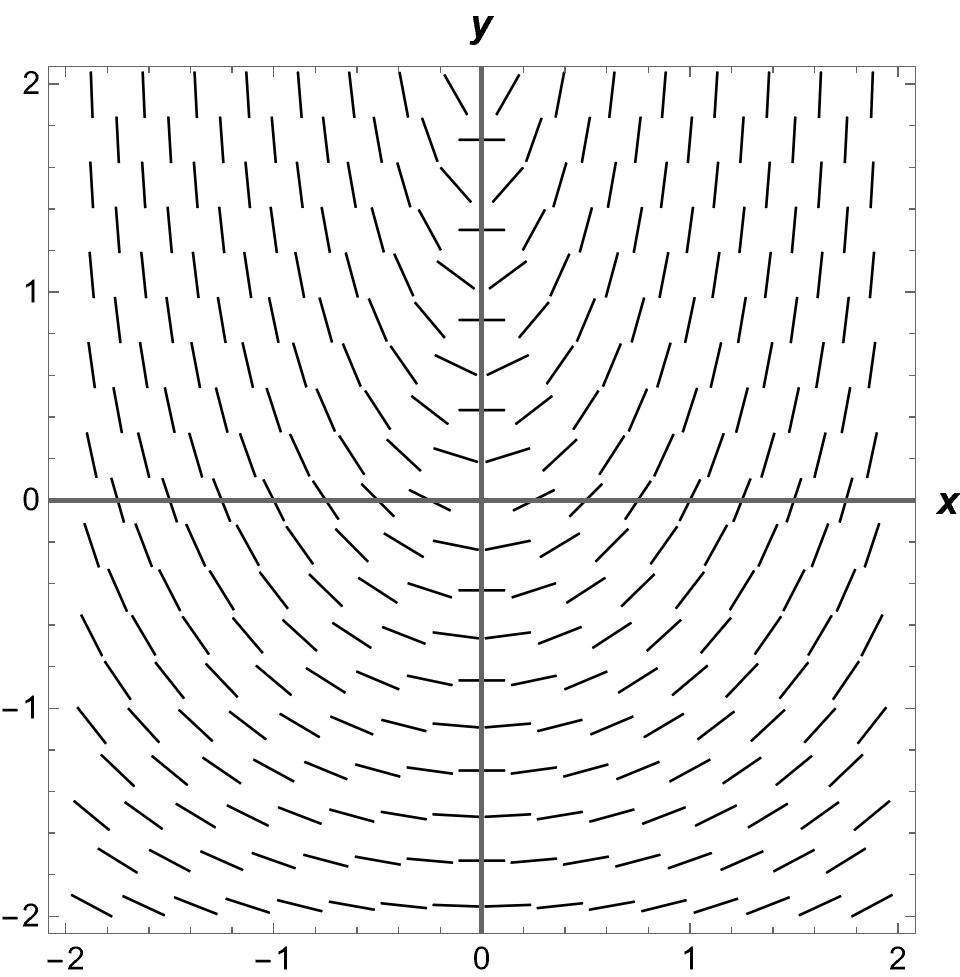
Let’s consider the first order separable differential equation \(y^{\,\prime }=2xe^y\).
(a)
Here is an (approximate) direction field for this differential equation on \([-2,2]\times [-2,2]\). Let’s draw (part of) the solution curve to this differential equation that
passes through the point \((0,0)\). Let’s use our drawing to estimate the value of
this solution when \(x=0.5\). Figure 1: A direction field
(b)
Does this equation have any constant solutions?
(c)
Let’s write this equation the form \(h(y)y^{\,\prime }=g(x)\).
(d)
Let’s integrate both sides with respect to \(x\).
(e)
Now let’s solve this differential equation for its general solution, and determine
the solution that passes through \((0,0)\).
(f)
How good was our estimate?
(g)
Let’s determine the interval \(I\) such that our solution is valid on \(I\), but not valid
on any interval \(J\neq I\) that contains \(I\).
 Applied Differential Equations