Homework 6 for MATH 128A.

MATH 128A: Homework 6 Due date: Thursday, May 14

Instructions. You will submit your solutions on Gradescope, which you can access through our Canvas course page by clicking on the assignment.

You are welcome to submit your homework either handwritten or in LaTeX. If you choose to submit handwritten work, please use pen rather than pencil, and make sure that both your handwriting and your scans are as readable as possible in order to facilitate grading.

I encourage you to attend office hours if you would like hints on the homework or if you would like to discuss more advanced material. Also, you are highly encouraged to work in groups!

(33 points) The affine plane of order \(3\) and its projective completion.

The goal of this problem is to draw the affine plane of order \(3\), determine its parallel classes, and then construct its projective completion.

(a)
(11 points) Draw an affine plane of order \(3\), i.e. an affine plane with \(9\) points.

Hint: You may arrange the \(9\) points in a \(3\times 3\) grid. The lines should have exactly \(3\) points each.

(b)
(11 points) Determine the parallel classes of lines in the affine plane you drew in part (a). In other words, group the lines into families of mutually parallel lines.

Hint: There should be \(4\) parallel classes, and each parallel class should contain \(3\) lines.

(c)
(11 points) Draw the projective completion of the affine plane of order \(3\) you drew in part (a).

Hint: Add one point at infinity for each parallel class of lines. Then extend each affine line by adding its corresponding point at infinity. Finally, add one new line at infinity incident with all the points at infinity.
Solution:

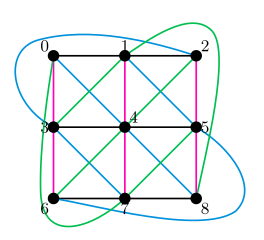
(a) Label the \(9\) points as follows:

\[ \begin{array}{ccc} 0 & 1 & 2\\ 3 & 4 & 5\\ 6 & 7 & 8 \end{array} \]

One affine plane of order \(3\) is obtained by taking the following \(12\) lines:

\[ \begin{array}{lll} \ell _{012}=\{0,1,2\}, & \ell _{345}=\{3,4,5\}, & \ell _{678}=\{6,7,8\},\\[2mm] \ell _{036}=\{0,3,6\}, & \ell _{147}=\{1,4,7\}, & \ell _{258}=\{2,5,8\},\\[2mm] \ell _{048}=\{0,4,8\}, & \ell _{156}=\{1,5,6\}, & \ell _{237}=\{2,3,7\},\\[2mm] \ell _{246}=\{2,4,6\}, & \ell _{138}=\{1,3,8\}, & \ell _{057}=\{0,5,7\}. \end{array} \]
Each line contains exactly \(3\) points.

[Picture]

(b) The parallel classes are

\[ \{\ell _{012},\ell _{345},\ell _{678}\}, \]
\[ \{\ell _{036},\ell _{147},\ell _{258}\}, \]
\[ \{\ell _{048},\ell _{156},\ell _{237}\}, \]
and
\[ \{\ell _{246},\ell _{138},\ell _{057}\}. \]
Thus there are \(4\) parallel classes, each containing \(3\) lines.

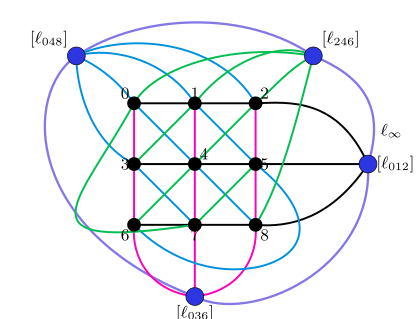
(c) To construct the projective completion, we add one point at infinity for each parallel class. We name these points by choosing one line from each class:

\[ [\ell _{012}],\qquad [\ell _{036}],\qquad [\ell _{048}],\qquad [\ell _{246}]. \]
Here
\[ [\ell _{012}]=[\ell _{345}]=[\ell _{678}], \]
\[ [\ell _{036}]=[\ell _{147}]=[\ell _{258}], \]
\[ [\ell _{048}]=[\ell _{156}]=[\ell _{237}], \]
and
\[ [\ell _{246}]=[\ell _{138}]=[\ell _{057}]. \]
Then we add the line at infinity
\[ \ell _\infty = \{[\ell _{012}],[\ell _{036}],[\ell _{048}],[\ell _{246}]\}. \]

In the picture below, the colors match the parallel classes above: black for \(\{\ell _{012},\ell _{345},\ell _{678}\}\), magenta for \(\{\ell _{036},\ell _{147},\ell _{258}\}\), blue for \(\{\ell _{048},\ell _{156},\ell _{237}\}\), and green for \(\{\ell _{246},\ell _{138},\ell _{057}\}\).

[Picture]

Therefore the projective completion has \(9+4=13\) points and \(12+1=13\) lines.

(33 points) Counting lines through a point in an affine plane.

Let \(\mathcal A=(\mathcal P,\mathcal L,\mathcal {R})\) be a finite affine plane of order \(n\). This means that every line is incident with exactly \(n\) points. You may also use the fact that \(|\mathcal P|=n^2\).

For a line \(r\in \mathcal L\), recall that \(R(r):=\{q\in \mathcal P:q\,I\,r\}\) denotes the set of points incident with \(r\).

Fix a point \(p\in \mathcal P\). The goal of this exercise is to prove that exactly \(n+1\) lines are incident with \(p\). Let \(r_1,\dots ,r_k\) be the distinct lines incident with \(p\). In other words, we assume that \(p\) is incident with exactly \(k\) lines, where \(k\ge 1\) is an integer we need to determine. Our goal is to show that \(k=n+1\).

(a)
(5 points) Show that every point \(q\in \mathcal P\setminus \{p\}\) lies on one of the lines \(r_1,\dots ,r_k\).
(b)
(5 points) Show that if \(i\neq j\), then
\[ \bigl (R(r_i)\setminus \{p\}\bigr )\cap \bigl (R(r_j)\setminus \{p\}\bigr )=\varnothing . \]
(c)
(5 points) Deduce that the sets \(R(r_1)\setminus \{p\},\dots ,R(r_k)\setminus \{p\}\) form a partition of \(\mathcal P\setminus \{p\}\).
(d)
(6 points) Explain why each set \(R(r_i)\setminus \{p\}\) has exactly \(n-1\) points.
(e)
(6 points) Deduce that \(n^2-1=k(n-1)\).
(f)
(6 points) Conclude that \(k=n+1\).

Therefore exactly \(n+1\) lines are incident with \(p\).

Solution:

Let \(r_1,\dots ,r_k\) be the distinct lines incident with \(p\).

(a) Let \(q\in \mathcal P\setminus \{p\}\). By axiom I1, there is a unique line through \(p\) and \(q\). Since \(r_1,\dots ,r_k\) are all the lines incident with \(p\), this line must be one of the \(r_i\). Hence \(q\) lies on one of the lines \(r_1,\dots ,r_k\).

(b) Suppose \(i\neq j\), and suppose for contradiction that

\[ q\in \bigl (R(r_i)\setminus \{p\}\bigr )\cap \bigl (R(r_j)\setminus \{p\}\bigr ). \]
Then \(q\neq p\), and both \(p\) and \(q\) are incident with \(r_i\) and with \(r_j\). By axiom I1, there is a unique line through the two distinct points \(p\) and \(q\). Therefore \(r_i=r_j\), contradicting \(i\neq j\). Hence
\[ \bigl (R(r_i)\setminus \{p\}\bigr )\cap \bigl (R(r_j)\setminus \{p\}\bigr )=\varnothing . \]

(c) By part (a), every point of \(\mathcal P\setminus \{p\}\) lies in one of the sets

\[ R(r_1)\setminus \{p\},\dots ,R(r_k)\setminus \{p\}. \]
By part (b), these sets are pairwise disjoint. Therefore they form a partition of \(\mathcal P\setminus \{p\}\).

(d) Since the affine plane has order \(n\), every line has exactly \(n\) points. Thus each \(R(r_i)\) has \(n\) points. Since \(p\in R(r_i)\), removing \(p\) leaves exactly \(n-1\) points:

\[ \left |R(r_i)\setminus \{p\}\right |=n-1. \]

(e) Since \(|\mathcal P|=n^2\), we have

\[ |\mathcal P\setminus \{p\}|=n^2-1. \]
By part (c), \(\mathcal P\setminus \{p\}\) is partitioned into \(k\) disjoint sets, each of size \(n-1\). Therefore
\[ n^2-1=k(n-1). \]

(f) Since

\[ n^2-1=(n-1)(n+1), \]
we get
\[ k(n-1)=(n-1)(n+1). \]
Since \(n\geq 2\), we have \(n-1\neq 0\), so we can divide by \(n-1\). Hence
\[ k=n+1. \]
Therefore exactly \(n+1\) lines are incident with \(p\).
(34 points) The projective completion of an affine plane.

Let \(\alpha =(\mathcal P,\mathcal L,\mathcal R)\) be an affine plane, and let \(\alpha ^\ast =(\mathcal P^\ast ,\mathcal L^\ast ,\mathcal R^\ast )\) be its projective completion, as introduced during W6L2. Recall that the points of \(\alpha ^\ast \) are the ordinary points of \(\mathcal P\), together with one point at infinity \([\ell ]\) for each parallel class of affine lines. The lines of \(\alpha ^\ast \) are the affine lines in \(\mathcal L\), together with one new line \(\ell _\infty \), called the line at infinity.

The goal of this problem is to show that \(\alpha ^\ast \) satisfies axiom I2, axiom I3, and the elliptic parallel property.

(a)
(5 points) Axiom I2 for affine lines. Show that every old line \(\ell \in \mathcal L\), is incident with at least three distinct points of \(\mathcal P^\ast \).
(b)
(5 points) Axiom I2 for the line at infinity. Show that the line at infinity \(\ell _\infty \) is incident with at least three distinct points of \(\mathcal P^\ast \).

Hint: Use axiom I3 in the affine plane to find three non-collinear ordinary points. Use these points to create three distinct parallel classes.

(c)
(4 points) Deduce that every line of \(\alpha ^\ast \) is incident with at least three distinct points.
(d)
(5 points) Show that \(\alpha ^\ast \) satisfies axiom I3; that is, show that there exist three points in \(\mathcal P^\ast \) which are not all incident with one common line.
(e)
(5 points) Show that any two distinct old lines \(\ell ,m\in \mathcal L\) meet in \(\alpha ^\ast \).

Hint: Distinguish between the case where \(\ell \) and \(m\) are parallel in the affine plane and the case where they aren’t.

(f)
(5 points) Show that every old line \(\ell \in \mathcal L\) meets the line at infinity \(\ell _\infty \).
(g)
(5 points) Conclude that \(\alpha ^\ast \) satisfies the elliptic parallel property; that is, any two distinct lines in \(\mathcal L^\ast \) meet.
Solution:

Recall that in the projective completion \(\alpha ^\ast \), each old affine line \(\ell \in \mathcal L\) is extended by adding the point at infinity \([\ell ]\) corresponding to its parallel class. The new line \(\ell _\infty \) is incident exactly with the points at infinity.

(a) Let \(\ell \in \mathcal L\) be an old affine line. By axiom I2 in the affine plane, \(\ell \) is incident with at least two distinct ordinary points. In the projective completion, \(\ell \) is also incident with the point at infinity \([\ell ]\). This point is not an ordinary point, so \(\ell \) is incident with at least three distinct points of \(\mathcal P^\ast \).

(b) By axiom I3 in the affine plane, there exist three ordinary points \(A,B,C\in \mathcal P\) which are not all incident with one common affine line.

Let \(\ell \) be the unique affine line incident with \(A\) and \(B\), let \(m\) be the unique affine line incident with \(A\) and \(C\), and let \(n\) be the unique affine line incident with \(B\) and \(C\).

We first claim that \(\ell ,m,n\) belong to three distinct parallel classes. Indeed, \(\ell \) and \(m\) both contain \(A\). If \(\ell =m\), then this one line would contain \(A\), \(B\), and \(C\), contradicting the choice of \(A,B,C\). Hence \(\ell \neq m\). Since \(\ell \) and \(m\) are distinct lines meeting at \(A\), they are not parallel, and therefore they cannot belong to the same parallel class.

Similarly, \(\ell \) and \(n\) are distinct lines meeting at \(B\), so they are not parallel and cannot belong to the same parallel class. Also, \(m\) and \(n\) are distinct lines meeting at \(C\), so they are not parallel and cannot belong to the same parallel class.

Thus \(\ell ,m,n\) determine three distinct parallel classes. Therefore the corresponding points at infinity

\[ [\ell ],\qquad [m],\qquad [n] \]
are three distinct points of \(\mathcal P^\ast \). All points at infinity are incident with the line at infinity \(\ell _\infty \), so \(\ell _\infty \) is incident with at least three distinct points.

(c) Every line of \(\alpha ^\ast \) is either an old affine line or the line at infinity. By parts (a) and (b), every such line is incident with at least three distinct points.

(d) By axiom I3 in the affine plane, there exist three ordinary points \(A,B,C\in \mathcal P\) which are not all incident with one common affine line. These same three points are also points of \(\mathcal P^\ast \).

They are not all incident with \(\ell _\infty \), because \(\ell _\infty \) contains only points at infinity. They are also not all incident with any old line, because that would mean they were collinear in the original affine plane. Therefore \(A,B,C\) are three points of \(\mathcal P^\ast \) which are not all incident with one common line. Hence \(\alpha ^\ast \) satisfies axiom I3.

(e) Let \(\ell ,m\in \mathcal L\) be two distinct old affine lines. If \(\ell \) and \(m\) are not parallel in the affine plane, then they meet in an ordinary point, so they also meet in \(\alpha ^\ast \).

If \(\ell \) and \(m\) are parallel in the affine plane, then they belong to the same parallel class. Hence

\[ [\ell ]=[m]. \]
In the projective completion, both \(\ell \) and \(m\) are incident with this common point at infinity. Therefore they meet in \(\alpha ^\ast \).

Thus any two distinct old lines meet in \(\alpha ^\ast \).

(f) Let \(\ell \in \mathcal L\) be an old affine line. In the projective completion, \(\ell \) is incident with the point at infinity \([\ell ]\). By definition, \([\ell ]\) is also incident with the line at infinity \(\ell _\infty \). Therefore \(\ell \) meets \(\ell _\infty \).

(g) Let \(L,M\in \mathcal L^\ast \) be two distinct lines. There are three cases.

If both \(L\) and \(M\) are old affine lines, then they meet by part (e). If one of them is an old affine line and the other is \(\ell _\infty \), then they meet by part (f). The remaining case, where both are \(\ell _\infty \), cannot occur because \(L\) and \(M\) are distinct.

Therefore any two distinct lines in \(\mathcal L^\ast \) meet. Hence \(\alpha ^\ast \) satisfies the elliptic parallel property.

Weekly reflection (2 bonus points).

Please answer in a few complete sentences. Your responses will be anonymous.

  • What is one idea from this week that you found interesting, surprising, or useful?
  • What is one idea from this week that still feels confusing?
  • What, if anything, makes it difficult for you to ask questions during lecture?
  • What, if anything, makes it difficult for you to attend class, section, or office hours?
  • Is there something I could do to make it easier for you to ask questions, attend section, or come to office hours?
Challenge problems (not graded).
(a)
(The Transylvania lottery and the Fano plane \(\dagger \)) In the Transylvania lottery, each ticket consists of three distinct numbers chosen from \(\{1,2,\dots ,14\}\). The winning ticket also consists of three distinct numbers. A ticket wins if at least two of its numbers match two of the winning numbers. Using Fano planes, show that one can buy \(14\) tickets and be certain of winning.
(b)
(Uniqueness of the affine plane of order \(3\) \(\dagger \)) Show that, up to isomorphism, there exists a unique affine plane with \(9\) points, i.e. a unique affine plane of order \(3\).
(c)
(Constructing an affine plane of order \(4\) \(\dagger \)) Construct an affine plane of order \(4\) using a diagram. That is, construct an affine plane with \(16\) points.