Je bent je ingevulde velden bij deze pagina aan het verwijderen. Ben je zeker dat je dit wilt doen?
You are erasing your filled-in fields on this page. Are you sure that is what you want?
Nieuwe Versie BeschikbaarNew Version Available
Er is een update van deze pagina. Als je update naar de meest recente versie, verlies je mogelijk je huidige antwoorden voor deze pagina. Hoe wil je verdergaan ?
There is an updated version of this page. If you update to the most recent version, then your current progress on this page will be erased. Regardless, your record of completion will remain. How would you like to proceed?
If \(a \neq 0\), we showed in Exercise quadraticderivativeformulaexercise in Section IntroductiontoDerivatives that if \(f(x) = ax^2 + bx + c\), then \(f'(x) = 2ax + b\). Solving \(f'(x) = 0\) produced \(x = -\frac {b}{2a}\), the \(x\)-coordinate of the vertex of the parabola \(y = f(x)\). This
Exercise shows this is part of a pattern.
If \(a \neq 0\), show the \(x\)-coordinate of the \(x\)-intercept of the graph of \(y = ax + b\) is \(x = -\frac {b}{a} = -\frac {b}{1 \, a}\).
To find the \(x\)-intercept, we set \(ax+b = 0\) and get \(x = -\frac {b}{a}\) provided \(a \neq 0\).
If \(a \neq 0\), for \(f(x) = ax^3 + bx^2 + cx + d\) it turns out that \(f''(x) = 6ax + 2b\). Show \(x = -\frac {b}{3a}\) is the \(x\)-coordinate of the inflection point of the graph of \(y = f(x)\).
The graph of \(f''(x) = 6ax + 2b\) is a line so we know on one side of \(x= - \frac {b}{3a}\), \(f''(x) > 0\) and on the other side, \(f''(x) < 0\).
Hence, the graph of the original function \(y = f(x)\) changes concavity at \(x = -\frac {b}{3a}\).
In Exercise AverageCostMarginalCostExercise in Section FunctionArithmetic, we observed that average cost appeared to be minimized when average cost was
approximately equal to marginal cost. In this Exercise, we use Calculus and the tools from this section to show
this.
Recall if \(C(x)\) is the cost to produce \(x\) items, the average cost is defined as \(\overline {C}(x) = \frac {C(x)}{x}\), \(x > 0\), is the cost per item.
It turns out that \(\overline {C}'(x) = \frac {x \, C'(x) - C(x)}{x^2}\). Show \(\overline {C}'(x) = 0\) when \(C'(x) = \overline {C}(x)\).
To solve \(\overline {C}'(x) = \frac {x \, C'(x) - C(x)}{x^2} = 0\), we set the numerator, \(x \, C'(x) - C(x) = 0\). We get \(x \, C'(x) = C(x)\) so \(C'(x) = \frac {C(x)}{x} = \overline {C}(x)\).
It turns out that \(\overline {C}''(x) = \frac {x^2 \, C''(x) - 2x\, C'(x) + 2C(x)}{x^3}\).
Show we can rewrite this as: \(\overline {C}''(x) = \frac {x \, C''(x) - 2\, C'(x) + 2 \overline {C}(x)}{x^2}\).
Divide both numerator and denominator of \(\overline {C}''(x) = \frac {x^2 \, C''(x) - 2x\, C'(x) + 2C(x)}{x^3}\) by \(x\):
It is usually assumed in most economic settings that for cost functions, \(C''(x) > 0\). (Can you think of reasons why?) Use this and
your results from parts avgcostcostderivequal and reduceavgcostseconderiv to prove that a minimum is produced when \(C'(x) = \overline {C}(x)\).
NOTE: In Exercise MarginalCostDerivativeExercise in Section IntroductiontoDerivatives, we saw how \(C'(x)\) can be used to approximate the marginal cost, \(MC(x)\), so we have established
that in order to minimize average cost, we should look where the average cost matches the marginal
cost.
When \(C'(x) = \overline {C}(x)\), we have that \(\overline {C}'(x) = 0\) and \(\overline {C}''(x) > 0\). By the Second Derivative Test for Local Extrema, Theorem secondderivatvetest, the average cost \(\overline {C}(x)\) has a
minimum when \(C'(x) = \overline {C}(x)\)
The complete graph of \(y = f(x)\) is shown below. Use the graph to answer the following questions.
NOTE: Assume \((2.029, 1.82)\) is a local maximum and that \((1.077, 0.948)\) is an inflection point.
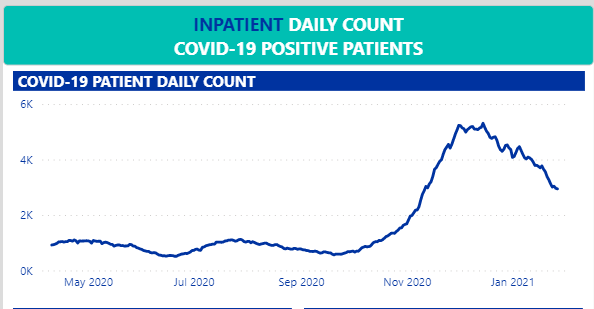
The graph below was taken from https://ohiohospitals.org/covid19data on January 28th, 2021:
With help from your classmate, highlight and label one segment on the graph which (roughly) represents the following
scenarios.
For brevity, we’ll use ‘patients’ to mean ‘inpatient COVID positive patients’ and ‘the rate of change’ to mean ‘the rate of change
of inpatient COVID positive patients with respect to time.’
The number of patients is decreasingand the rate of change is decreasing. (Label this ‘a.’)
The number of patients is decreasingand the rate of change is increasing. (Label this ‘b.’)
The number of patients is increasingand the rate of change is increasing. (Label this ‘c.’)
The number of patients is increasingand the rate of change is decreasing. (Label this ‘d.’)
Discuss with your classmates what the phrase ‘flatten the curve’ could mean in terms of first and second
derivatives. (See below for an illustration.)

![[Picture]](ExercisesforAppDerivatives.online-9ba124908a2a6dc23edfe7fba4c0f040.svg)
![[Picture]](ExercisesforAppDerivatives.online-48af55b5ca217dd3e4c6777b6566c7d7.svg)
![[Picture]](ExercisesforAppDerivatives.online-80bd917ead3765b4186bcfc9a952ff62.svg)