Je bent je ingevulde velden bij deze pagina aan het verwijderen. Ben je zeker dat je dit wilt doen?
You are erasing your filled-in fields on this page. Are you sure that is what you want?
Nieuwe Versie BeschikbaarNew Version Available
Er is een update van deze pagina. Als je update naar de meest recente versie, verlies je mogelijk je huidige antwoorden voor deze pagina. Hoe wil je verdergaan ?
There is an updated version of this page. If you update to the most recent version, then your current progress on this page will be erased. Regardless, your record of completion will remain. How would you like to proceed?
In Exercises firstlawofsines - lastlawofsines, solve for the remaining side(s) and angle(s) if possible. Round angles to the nearest tenth
of a degree, and lengths to the nearest hundredth of a unit. As in the text, \((\alpha , a)\), \((\beta , b)\) and \((\gamma , c)\) are angle-side opposite
pairs.
The area of the triangle from Exercise firstlawofsines is about 8.1 square units. The area of the triangle from Exercise secondarea is about 377.1 square units. The area of the triangle from Exercise lastlawofsines is about 149 square units.
The Grade of a Road: The grade of a road is much like the pitch of a roof (See Example roofpitchex) in that it expresses the ratio of
rise/run. In the case of a road, this ratio is always positive because it is measured going uphill and it is usually given as a
percentage. For example, a road which rises 7 feet for every 100 feet of (horizontal) forward progress is said to have a 7%
grade. However, if we want to apply any Trigonometry to a story problem involving roads going uphill or downhill, we need to
view the grade as an angle with respect to the horizontal. In Exercises firstroadgrade - lastroadgrade, we first have you change road grades into angles
and then use the Law of Sines in an application.
Using a right triangle with a horizontal leg of length 100 and vertical leg with length 7, show that a 7% grade
means that the road (hypotenuse) makes about a \(4^{\circ }\) angle with the horizontal. (It will not be exactly \(4^{\circ }\), but it’s pretty
close.)
\(\arctan \left (\frac {7}{100}\right ) \approx 0.699\) radians, which is equivalent to \(4.004^{\circ }\)
What grade is given by a \(9.65^{\circ }\) angle made by the road and the horizontal? (I have friends who live in Pacifica, CA and their
road is actually this steep. It’s not a nice road to drive.)
About 17%
Along a long, straight stretch of mountain road with a 7% grade, you see a tall tree standing perfectly plumb alongside the
road. (The word ‘plumb’ here means that the tree is perpendicular to the horizontal.) From a point 500 feet downhill from
the tree, the angle of inclination from the road to the top of the tree is \(6^{\circ }\). Use the Law of Sines to find the height of the
tree.
First show that the tree makes a \(94^{\circ }\) angle with the road.
Find the angle \(\theta \) in standard position with \(0^{\circ } \leq \theta < 360^{\circ }\) which corresponds to each of the bearings given below.
due west
\(\theta = 180^{\circ }\)
S\(83^{\circ }\)E
\(\theta = 353^{\circ }\)
N\(5.5^{\circ }\)E
\(\theta = 84.5^{\circ }\)
due south
\(\theta = 270^{\circ }\)
N\(31.25^{\circ }\)W
\(\theta = 121.25^{\circ }\)
S\(72^{\circ }41'12''\)W (See Example degreeex in Section AppAngles for a review of the DMS system.)
\(\theta = 197^{\circ } 18' 48''\)
N\(45^{\circ }\)E
\(\theta = 45^{\circ }\)
S\(45^{\circ }\)W
\(\theta = 225^{\circ }\)
The Colonel spots a campfire at a of bearing N\(42^{\circ }\)E from his current position. Sarge, who is positioned 3000 feet due east of
the Colonel, reckons the bearing to the fire to be N\(20^{\circ }\)W from his current position. Determine the distance from the campfire to
each man, rounded to the nearest foot.
The Colonel is about 3193 feet from the campfire. Sarge is about 2525 feet to the campfire.
A hiker starts walking due west from Sasquatch Point and gets to the Chupacabra Trailhead before she realizes that she
hasn’t reset her pedometer. From the Chupacabra Trailhead she hikes for 5 miles along a bearing of N\(53^{\circ }\)W which brings her to
the Muffin Ridge Observatory. From there, she knows a bearing of S\(65^{\circ }\)E will take her straight back to Sasquatch Point. How far
will she have to walk to get from the Muffin Ridge Observatory to Sasquach Point? What is the distance between Sasquatch
Point and the Chupacabra Trailhead?
The distance from the Muffin Ridge Observatory to Sasquach Point is about 7.12 miles. The distance from Sasquatch Point to the Chupacabra Trailhead is about 2.46 miles.
The captain of the SS Bigfoot sees a signal flare at a bearing of N\(15^{\circ }\)E from her current location. From his position, the captain
of the HMS Sasquatch finds the signal flare to be at a bearing of N\(75^{\circ }\)W. If the SS Bigfoot is 5 miles from the HMS Sasquatch
and the bearing from the SS Bigfoot to the HMS Sasquatch is N\(50^{\circ }\)E, find the distances from the flare to each vessel, rounded to
the nearest tenth of a mile.
The SS Bigfoot is about 4.1 miles from the flare. The HMS Sasquatch is about 2.9 miles from the flare.
Carl spies a potential Sasquatch nest at a bearing of N\(10^{\circ }\)E and radios Jeff, who is at a bearing of N\(50^{\circ }\)E from Carl’s position.
From Jeff’s position, the nest is at a bearing of S\(70^{\circ }\)W. If Jeff and Carl are 500 feet apart, how far is Jeff from the Sasquatch
nest? Round your answer to the nearest foot.
Jeff is about 371 feet from the nest.
A hiker determines the bearing to a lodge from her current position is S\(40^{\circ }\)W. She proceeds to hike 2 miles at a bearing of S\(20^{\circ }\)E
at which point she determines the bearing to the lodge is S\(75^{\circ }\)W. How far is she from the lodge at this point? Round your answer
to the nearest hundredth of a mile.
She is about 3.02 miles from the lodge
A watchtower spots a ship off shore at a bearing of N\(70^{\circ }\)E. A second tower, which is 50 miles from the first at a bearing of S\(80^{\circ }\)E
from the first tower, determines the bearing to the ship to be N\(25^{\circ }\)W. How far is the boat from the second tower? Round your
answer to the nearest tenth of a mile.
The boat is about 25.1 miles from the second tower.
Skippy and Sally decide to hunt UFOs. One night, they position themselves 2 miles apart on an abandoned stretch of
desert runway. An hour into their investigation, Skippy spies a UFO hovering over a spot on the runway directly between him
and Sally. He records the angle of inclination from the ground to the craft to be \(75^{\circ }\) and radios Sally immediately to find the angle
of inclination from her position to the craft is \(50^{\circ }\). How high off the ground is the UFO at this point? Round your answer to the
nearest foot. (Recall: 1 mile is 5280 feet.)
The UFO is hovering about 9539 feet above the ground.
The angle of depression from an observer in an apartment complex to a gargoyle on the building next door is \(55^{\circ }\). From a point
five stories below the original observer, the angle of inclination to the gargoyle is \(20^{\circ }\). Find the distance from each observer to the
gargoyle and the distance from the gargoyle to the apartment complex. Round your answers to the nearest foot. (Use the rule
of thumb that one story of a building is 9 feet.)
The gargoyle is about 44 feet from the observer on the upper floor. The gargoyle is about 27 feet from the observer on the lower floor. The gargoyle is about 25 feet from the other building.
A villainous trio from a copyrighted anime ascends vertically in their hot air balloon from a point on level ground at a
constant rate of \(6\) feet per second. Let \(\theta \) be the angle of inclination to the base of the balloon basket from a point on the ground
40 feet away from the launch point.
Let \(h\) denote the height of the balloon off of the ground. Show \(h = 40 \sin (\theta )\).
Use the related rate law: (Theorem relatedratesaroc in Section RelatedRates)\(\frac {\Delta h}{\Delta t} = \frac {\Delta h}{\Delta \theta } \, \frac {\Delta \theta }{\Delta t}\) to help you find the rate of change of \(\theta \) with respect to
time as \(\theta \) increases from \(60^{\circ }\) to \(60.1^{\circ }\). Remember to give units.
\(\frac {\Delta h}{\Delta t}\) is given as a constant \(6 \, \frac {\text {ft}}{\text {s}}\). \(\frac {\Delta h}{\Delta \theta } = \frac {h(60.1) - h(60)}{0.1} \approx 0.348 \, \frac {\text {ft}}{\text {degree, } \, \circ }\).
The angle of elevation is increasing at an average rate of \(17.215\) degrees per second. WARNING: For (good) reasons you’ll
explore more deeply in Calculus, you’ll usually stick with radians when the Calculus version of this problem rolls around
…
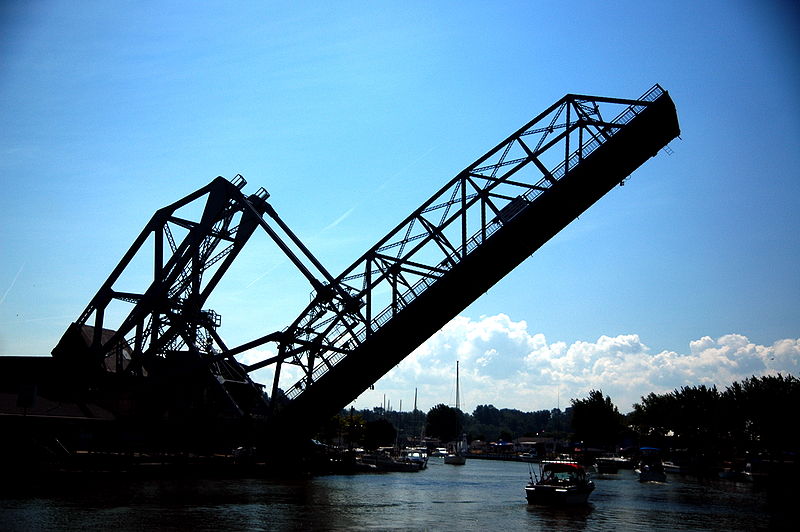
It takes 2 minutes for the 160 foot Ashtabula Bascule Lift Bridge to rotate \(45^{\circ }\) from its horizontal position to its raised position,
as seen below. (You can see a video of the bridge being raised here.)
Assume the bridge casts a shadow directly below itself the entire time it is being raised, (That is, the sun is directly
overhead of the bridge and is shining for an entire two minutes... which never actually happens.)
Let \(s\) denote the length of the shadow of the bridge on the water. Show \(s = 160 \cos (\theta )\).
Assuming the angle of elevation of the bridge changes at a constant rate, use the related rate law: (Theorem relatedratesaroc in Section RelatedRates)\(\frac {\Delta s}{\Delta t} = \frac {\Delta s}{\Delta \theta } \, \frac {\Delta \theta }{\Delta t}\) to help you find the rate of change of the shadow length with respect to time as \(\theta \)
increases from \(30^{\circ }\) to \(30.1^{\circ }\). Remember to give units.
This means the shadow is receding at a rate of approximately 31.436 feet per minute.
WARNING: For (good) reasons you’ll explore more deeply in Calculus, you’ll usually stick with radians when the
Calculus version of this problem rolls around …
Prove that the Law of Sines holds when \(\triangle ABC\) is a right triangle.
Discuss with your classmates why knowing only the three angles of a triangle is not enough to determine any of the sides.
Discuss with your classmates why the Law of Sines cannot be used to find the angles in the triangle when only the three
sides are given. Also discuss what happens if only two sides and the angle between them are given. (Said another way,
explain why the Law of Sines cannot be used in the SSS and SAS cases.)
Given \(\alpha = 30^{\circ }\) and \(b = 10\), choose four different values for \(a\) so that
the information yields no triangle
the information yields exactly one right triangle
the information yields two distinct triangles
the information yields exactly one obtuse triangle
Explain why you cannot choose \(a\) in such a way as to have \(\alpha = 30^{\circ }\), \(b = 10\) and your choice of \(a\) yield only one triangle where that unique
triangle has three acute angles.
Use the cases and diagrams in the proof of the Law of Sines (Theorem lawofsines) to prove the area formulas given
in Theorem areaformulasine. Why do those formulas yield square units when four quantities are being multiplied together?