 PreCalculus
- Verberg vooruitgang Hide progress Toon vooruitgang Show progress
- Verwijder je antwoorden (op deze pagina) Remove your answers (on this page)
PreCalculusThe word ‘trigonometry’ literally means ‘measuring triangles,’ so naturally most students’ first introduction to trigonometry focuses on triangles. This section focuses on right triangles, triangles in which one angle measures \(90^{\circ }\). Consider the right triangle below, where, as usual, a small square denotes the right angle, the labels ‘\(a\),’ ‘\(b\),’ and ‘\(c\)’ denote the lengths of the sides of the triangle, and \(\alpha \) and \(\beta \) represent the (measure of) the non-right angles. As you may recall, the side opposite the right angle is called the hypotenuse of the right triangle. Also note that since the sum of the measures of all angles in a triangle must add to \(180^{\circ }\), we have \(\alpha + \beta + 90^{\circ }= 180^{\circ }\), or \(\alpha + \beta = 90^{\circ }\). Said differently, the non-right angles in a right triangle are complements.
![[Picture]](AppRightTrig.online-39f36cd3d03c1f6564931fa857cd79c5.svg)
We now state and prove the most famous result about right triangles: The Pythagorean Theorem.
There are several proofs of the Pythagorean Theorem, but the one we choose to reproduce here showcases a nice interplay between algebra and geometry. Consider taking four copies of the right triangle below on the left and arranging them as seen below on the right.
![[Picture]](AppRightTrig.online-3f8e81488bc5d786485b0ebeab9544f4.svg)
![[Picture]](AppRightTrig.online-c46dc1fb5af3f3db27da82f2efb7579a.svg)
It should be clear that we have produced a large square with a side length of \((a+b)\). What is also true, but may not be obvious, is that the shaded quadrilateral is also a square. We can readily see the shaded quadrilateral has equal sides of length \(c\). Moreover, since \(\alpha + \beta = 90^{\circ }\), we get the interior angles of the shaded quadrilateral are each \(90^{\circ }\). Hence, the shaded quadrilateral is indeed a square.
We finish the proof by computing the area of the of the large square in two ways. First, we square the length of its side: \((a+b)^2\). Next, we add up the areas of the four triangles, each having area \(\frac {1}{2} ab\) along with the area of the shaded square, \(c^2\). Equating these to expressions gives: \((a+b)^2 = 4 \left ( \frac {1}{2} ab\right )+c^2\). Since \((a+b)^2 = a^2+2ab+b^2\) and \(4 \left ( \frac {1}{2} ab\right ) = 2ab\), we have \(a^2+2ab+b^2 = 2ab + c^2\) or \(a^2+b^2 = c^2\), as required.
It should be noted that the converse of the Pythagorean Theorem is also true. That is if \(a\), \(b\), and \(c\) are the lengths of sides of a triangle and \(a^2+b^2 = c^2\), then \(c\) the triangle is a right triangle.
A list of integers \((a,b,c)\) which satisfy the relationship \(a^2+b^2 = c^2\) is called a Pythagorean Triple. Some of the more common triples are: \((3,4,5)\), \((5,12,13)\), \((7,24,25)\), and \((8,15,17)\). We leave it to the reader to verify these integers satisfy the equation \(a^2+b^2 = c^2\) and suggest committing these triples to memory.
Next, we set about defining characteristic ratios associated with acute angles. Given any acute angle \(\theta \), we can imagine \(\theta \) being an interior angle of a right triangle as seen below.
![[Picture]](AppRightTrig.online-8a70f0fc24bb7f2c224242f4e8aea466.svg)
Focusing on the arrangement of the sides of the triangle with respect to the angle \(\theta \), we make the following definitions: the side with length \(a\) is called the side of the triangle which is adjacent to \(\theta \) and the side with length \(b\) is called the side of the triangle opposite \(\theta \). As usual, the side labeled ‘\(c\)’ (the side opposite the right angle) is the hypotenuse. Using this diagram, we define three important trigonometric ratios of \(\theta \).
For example, consider the angle \(\theta \) indicated in the triangle below on the left. Using Definition righttrianglesinecosinetangent, we get \(\sin (\theta ) = \frac {4}{5}\), \(\cos (\theta ) = \frac {3}{5}\), and \(\tan (\theta ) = \frac {4}{3}\). One may well wonder if these trigonometric ratios we’ve found for \(\theta \) change if the triangle containing \(\theta \) changes. For example, if we scale all the sides of the triangle below on the left by a factor of \(2\), we produce the similar triangle below in the middle. Using this triangle to compute our ratios for \(\theta \), we find \(\sin (\theta ) = \frac {8}{10} = \frac {4}{5}\), \(\cos (\theta ) = \frac {6}{10} = \frac {3}{5}\), and \(\tan (\theta ) = \frac {8}{6} = \frac {4}{3}\). Note that the scaling factor, here \(2\), is common to all sides of the triangle, and, hence, cancels from the numerator and denominator when simplifying each of the ratios.
![[Picture]](AppRightTrig.online-d3b48cc8c2ff7c22755afe08cf68d404.svg)
In general, thanks to the Angle Angle Similarity Postulate, any two right triangles which contain our angle \(\theta \) are similar which means there is a positive constant \(r\) so that the sides of the triangle are \(3r\), \(4r\), and \(5r\) as seen above on the right. Hence, regardless of the right triangle in which we choose to imagine \(\theta \), \(\sin (\theta ) = \frac {4r}{5r} = \frac {4}{5}\), \(\cos (\theta ) = \frac {3r}{5r} = \frac {3}{5}\), and \(\tan (\theta ) = \frac {4r}{3r} = \frac {4}{3}\). Generalizing this same argument to any acute angle \(\theta \) assures us that the ratios as described in Definition righttrianglesinecosinetangent are independent of the triangle we use.
Our next objective is to determine the values of \(\sin (\theta )\), \(\cos (\theta )\), and \(\tan (\theta )\) for some of the more commonly used angles. We begin with \(45^{\circ }\). In a right triangle, if one of the non-right angles measures \(45^{\circ }\), then the other measures \(45^{\circ }\) as well. It follows that the two legs of the triangle must be congruent. Since we may choose any right triangle containing a \(45^{\circ }\) angle for our computations, we choose the length of one (hence both) of the legs to be \(1\). The Pythagorean Theorem gives the hypotenuse is: \(c^2 = 1^2+1^2 = 2\), so \(c = \sqrt {2}\). (We take only the positive square root here since \(c\) represents the length of the hypotenuse here, so, necessarily \(c>0\).) From this, we obtain the values below, and suggest committing them to memory.
![[Picture]](AppRightTrig.online-f6dd60a7ac68236d10196e3197ae02c7.svg)
Trigonometric ratios for \(45^{\circ }\):
Note that we have ‘rationalized’ here to avoid the irrational number \(\sqrt {2}\) appearing in the denominator. This is a common convention in trigonometry, and we will adhere to it unless extremely inconvenient.
Next, we investigate \(60^{\circ }\) and \(30^{\circ }\) angles. Consider the equilateral triangle below each of whose sides measures \(2\) units. Each of its interior angles is necessarily \(60^{\circ }\), so if we drop an altitude, we produce two \(30^{\circ } - 60^{\circ } - 90^{\circ }\) triangles each having a base measuring \(1\) unit and a hypotenuse of \(2\) units. Using the Pythagorean Theorem, we can find the height, \(h\) of these triangles: \(1^2+h^2 = 2^2\) so \(h^2 = 3\) or \(h = \sqrt {3}\). Using these, we can find the values of the trigonometric ratios for both \(60^{\circ }\) and \(30^{\circ }\). Again, we recommend committing these values to memory.
![[Picture]](AppRightTrig.online-6e0d94d3753ae7f558ab3fb3b15d7bf5.svg)
Trigonometric ratios for \(60^{\circ }\):
Trigonometric ratios for \(30^{\circ }\):
Note that since \(30^{\circ }\) and \(60^{\circ }\) are complements, the side adjacent to the \(60^{\circ }\) angle is the side opposite the \(30^{\circ }\) and the side opposite the \(60^{\circ }\) angle is the side adjacent to the \(30^{\circ }\) . Hence, the ‘co’-sine of \(30^{\circ }\) is the sine of its ‘co’mplement, \(60^{\circ }\) and vice-versa. This sort of ‘swapping’ is true of all complementary angles and will be generalized in Section MoreTrigonometricIdentities, Theorem cofunctionidentities.
Note that the values of the trigonometric ratios we have derived for \(30^{\circ }\), \(45^{\circ }\), and \(60^{\circ }\) angles are the exact values of these ratios. For these angles, we can conveniently express the exact values of their sines, cosines, and tangents resorting, at worst, to using square roots. The reader may well wonder if, for instance, we can express the exact value of, say, \(\sin \left (42^{\circ }\right )\) in terms of radicals. The answer in this case is ‘yes’ (see here), but, in general, we will not take the time to pursue such representations. Hence, if a problem requests an ‘exact’ answer involving \(\sin \left (42^{\circ }\right )\), we will leave it written as ‘\(\sin \left (42^{\circ }\right )\)’ and use a calculator to produce a suitable approximation as the situation warrants.
Our first example requires the concept of an ‘angle of inclination.’ The angle of inclination (or angle of elevation) of an object refers to the angle whose initial side is some kind of base-line (say, the ground), and whose terminal side is the line-of-sight to an object above the base-line. Schematically:
![[Picture]](AppRightTrig.online-b2fb1d8e9a3257b0e0f57d08d889d753.svg)
We can represent the problem situation using a right triangle as shown below. If we let \(h\) denote the height of the tower, then we have \(\tan \left (60^{\circ }\right ) = \frac {h}{30}\).
![[Picture]](AppRightTrig.online-eb0f837a9aa0d95f309f6aabfb0530ac.svg)
From this we get an exact answer of \(h = 30 \tan \left (60^{\circ }\right ) = 30 \sqrt {3}\) feet. Using a calculator, we get the approximation \(51.96\) which, when rounded to the nearest foot, gives us our answer of \(52\) feet.
We diagram the situation below using \(\ell \) to represent the unknown length of the ramp.
![[Picture]](AppRightTrig.online-59dd0f1ec5d6ecd140aa5dcdfca33f1f.svg)
We have \(\sin \left (5^{\circ } \right )= \frac {21}{\ell }\) so that \(\ell = \frac {21}{\sin \left (5^{\circ } \right )} \approx 240.95\) inches. Hence, the ramp is \(241\) inches long.
Sketching the problem situation below, we find ourselves with two unknowns: the height \(h\) of the tree and the distance \(x\) from the base of the tree to the first observation point.
![[Picture]](AppRightTrig.online-22fe9629797c67f32ad7fc9153493f36.svg)
Luckily, we have two right triangles to help us find each unknown, as shown below. From the triangle below on the left, we get \(\tan \left (45^{\circ }\right ) = \frac {h}{x}\). From the triangle below on the right, we see \(\tan \left (30^{\circ }\right ) = \frac {h}{x+200}\).
![[Picture]](AppRightTrig.online-9e67914453dd045700e1c4c0012d2642.svg)
Since \(\tan \left (45^{\circ }\right ) = 1\), the first equation gives \(\frac {h}{x} = 1\), or \(x = h\). Substituting this into the second equation gives \(\frac {h}{h+200} = \tan \left (30^{\circ }\right ) = \frac {\sqrt {3}}{3}\). Clearing fractions, we get \(3h = (h+200) \sqrt {3}\). The result is a linear equation for \(h\), so we expand the right hand side and gather all the terms involving \(h\) to one side.
Hence, the tree is approximately \(273\) feet tall.
There are three more trigonometric ratios which are commonly used and they are defined in the same manner the ratios in Definition righttrianglesinecosinetangent are defined. They are listed below.
Suppose \(\theta \) is an acute angle residing in a right triangle as depicted on page 3.
We practice these definitions in the following example.
![[Picture]](AppRightTrig.online-bf80b08aaf3fb6a959a2b3156b4da65a.svg)
From the diagram, we see immediately \(\tan (\theta ) = \frac {1}{3}\), but in order to determine the remaining four trigonometric ratios, we need to first find the value of the hypotenuse. The Pythagorean Theorem gives \(1^2 + 3^2 = c^2\) so \(c^2 = 10\) or \(c = \sqrt {10}\). Rationalizing denominators, we find \(\sin (\theta ) = \frac {1}{\sqrt {10}} = \frac {\sqrt {10}}{10}\), \(\cos (\theta ) = \frac {3}{\sqrt {10}} = \frac {3\sqrt {10}}{10}\), \(\csc (\theta ) = \frac {\sqrt {10}}{1} = \sqrt {10}\) and \(\sec (\theta ) = \frac {\sqrt {10}}{3}\).
While we learned all about the trigonometric ratios of \(\theta \) in Example righttriangleex2, the identity of \(\theta \) remains unknown. Since \(\sin (\theta ) = \frac {\sqrt {10}}{10} \approx 0.316 \) is decidedly less than \(\sin \left (30^{\circ }\right ) = \frac {1}{2} = 0.5\), it stands to reason that \(\theta < 30^{\circ }\). It turns out the calculator can provide for us a decimal approximation of \(\theta \) by way of the ‘\(\sin ^{-1}(x)\)’ function. Here, the ‘\(-1\)’ exponent denotes an inverse function (see Section InverseFunctions) does not mean reciprocal. That is, \(\sin ^{-1}(x)\) (read ‘sine-inverse of \(x\)’) gives an angle whose sine is \(x\). Hence, we may write \(\theta = \sin ^{-1}\left (\frac {\sqrt {10}}{10}\right ) \approx 18.43^{\circ }\). The functions \(\cos ^{-1}(x)\) and \(\tan ^{-1}(x)\) work similarly. Indeed,
and the reader is encouraged to use a calculator to verify these statements.
Please note there is much more to these inverse functions than the ‘angle finder’ description use here. That being said, we finish this section showcasing a use for the \(\tan ^{-1}(x)\) function below.
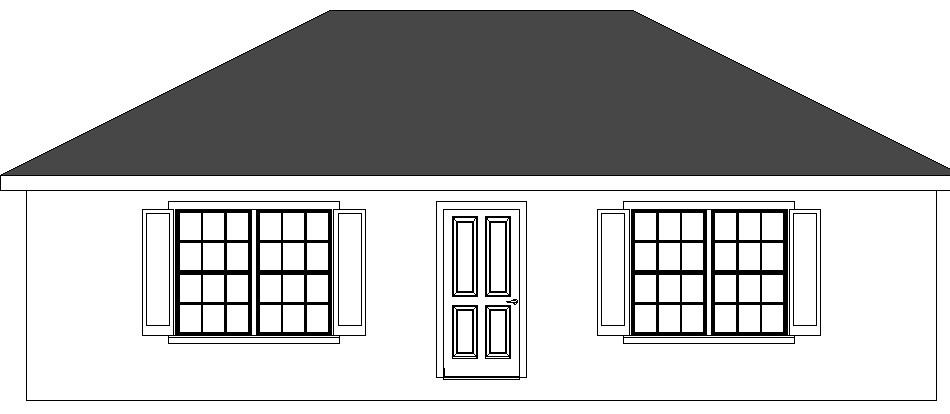 |
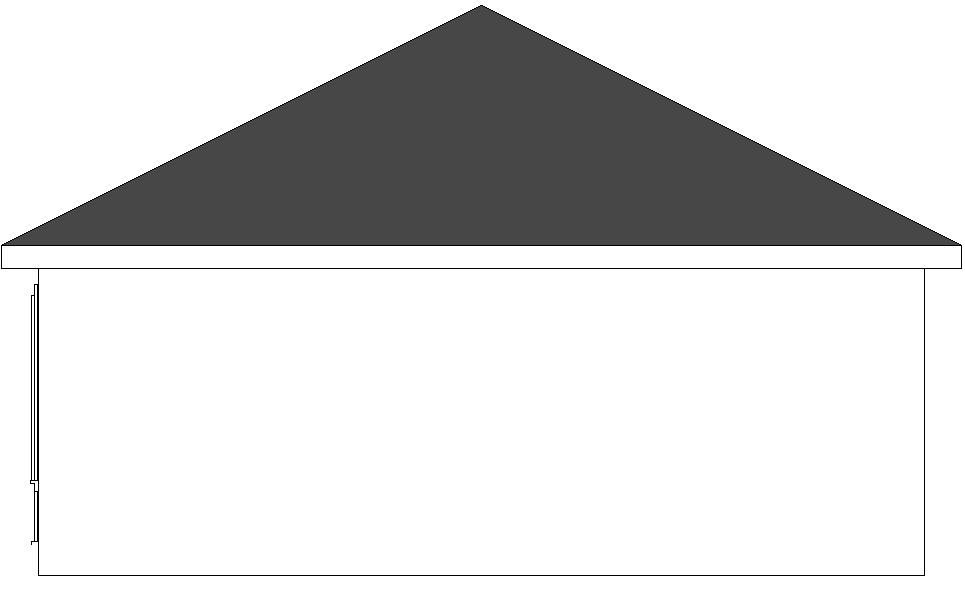 |
| Front View | Side View |
![[Picture]](AppRightTrig.online-138d971fc407ebb854ebadef0add04c6.svg)
The angle of inclination, \(\theta \), satisfies \(\tan (\theta ) = \frac {6}{12} = \frac {1}{2}\). Hence, \(\theta = \tan ^{-1}\left ( \frac {1}{2}\right ) \approx 26.56^{\circ }\).