Je bent je ingevulde velden bij deze pagina aan het verwijderen. Ben je zeker dat je dit wilt doen?
You are erasing your filled-in fields on this page. Are you sure that is what you want?
Nieuwe Versie BeschikbaarNew Version Available
Er is een update van deze pagina. Als je update naar de meest recente versie, verlies je mogelijk je huidige antwoorden voor deze pagina. Hoe wil je verdergaan ?
There is an updated version of this page. If you update to the most recent version, then your current progress on this page will be erased. Regardless, your record of completion will remain. How would you like to proceed?
In Exercises polarplotfirst - polarplotlast, plot the graph of the polar equation by hand. Carefully label your graphs.
Circle: \(r = 6\sin (\theta )\)
Circle: \(r = 2\cos (\theta )\)
Rose: \(r = 2\sin (2\theta )\)
Rose: \(r = 4\cos (2\theta )\)
Rose: \(r = 5\sin (3\theta )\)
Rose: \(r = \cos (5\theta )\)
Rose: \(r = \sin (4\theta )\)
Rose: \(r = 3\cos (4\theta )\)
Cardioid: \(r = 3 - 3\cos (\theta )\)
Cardioid: \(r = 5 + 5\sin (\theta )\)
Cardioid: \(r = 2 + 2\cos (\theta )\)
Cardioid: \(r = 1 - \sin (\theta )\)
Limaçon: \(r = 1 - 2\cos (\theta )\)
Limaçon: \(r = 1 - 2\sin (\theta )\)
Limaçon: \(r = 2\sqrt {3} + 4\cos (\theta )\)
Limaçon: \(r = 3-5\cos (\theta )\)
Limaçon: \(r = 3-5\sin (\theta )\)
Limaçon: \(r = 2 + 7\sin (\theta )\)
Lemniscate: \(r^{2} = \sin (2\theta )\)
Lemniscate: \(r^{2} = 4\cos (2\theta )\)
In Exercises findpolarintfirst - findpolarintlast, sketch the graph of the polar curves to help you find the exact polar coordinates of the points of intersection
of graphs of the polar equations. Remember to check for intersection at the pole (origin).
In Exercises setbuildpolarfirst - setbuildpolarlast, use set-builder notation to describe the polar region. Assume that the region contains its bounding
curves.
While the authors truly believe that graphing polar curves by hand is fundamental to your understanding of the polar
coordinate system, we would be derelict in our duties if we totally ignored the graphing utility. (As of this writing, while
free online websites and apps like desmos are gaining popularity, the TI-83/84 series calculators are still in wide circulation.)
Indeed, there are some important polar curves which are simply too difficult to graph by hand and that makes the calculator
an important tool for your further studies in Mathematics, Science and Engineering. We now give a brief demonstration of how
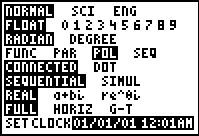
to use the graphing utility to plot polar curves. The first thing you must do is switch the MODE of your calculator to POL, which
stands for “polar”.
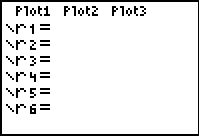
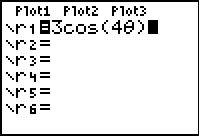
This changes the “Y=” menu as seen above in the middle. Let’s plot the polar rose given by \(r = 3\cos (4\theta )\) from Exercise roseexercise8petal above. We type
the function into the “r=” menu as seen above on the right. We need to set the viewing window so that the curve displays
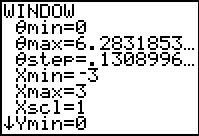
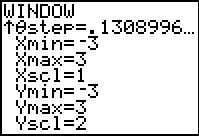
properly, but when we look at the WINDOW menu, we find three extra lines.
In order for the calculator to be able to plot \(r = 3\cos (4\theta )\) in the \(xy\)-plane, we need to tell it not only the dimensions which \(x\) and \(y\) will assume,
but we also what values of \(\theta \) to use. From our previous work, we know that we need \(0 \leq \theta \leq 2\pi \), so we enter the data you see above. (I’ll
say more about the \(\theta \)-step in just a moment.) Hitting GRAPH yields the curve below on the left which doesn’t look quite right.
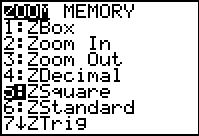
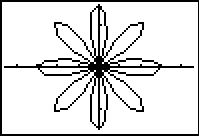
The issue here is that the calculator screen is 96 pixels wide but only 64 pixels tall. To get a true geometric perspective, we
need to hit ZOOM SQUARE (seen below in the middle) to produce a more accurate graph which we present below on the
right.
In function mode, the calculator automatically divided the interval [Xmin, Xmax] into 96 equal subintervals. In polar mode,
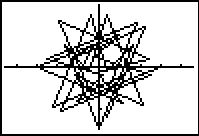
however, we must specify how to split up the interval [\(\theta \)min, \(\theta \)max] using the \(\theta \)step. For most graphs, a \(\theta \)step of 0.1 is fine. If you
make it too small then the calculator takes a long time to graph. It you make it too big, you get chunky garbage like
this.
You will need to experiment with the settings in order to get a nice graph.
Exercises polarcalcfirst - polarcalclast give you some curves to graph using your calculator. Note some of them have explicit bounds on \(\theta \) and others do
not.
Use a graphing utility to graph \(r = a - b \sin (\theta )\) for various (positive) values of \(a\) and \(b\). Describe the shape of the curve when \(a = b\), \(a < b\), and when \(a > b\).
How many petals does the polar rose \(r = \sin (2\theta )\) have? What about \(r = \sin (3\theta )\), \(r = \sin (4\theta )\) and \(r = \sin (5\theta )\)? With the help of your classmates, make a conjecture as to
how many petals the polar rose \(r = \sin (n\theta )\) has for any natural number \(n\). Replace sine with cosine and repeat the investigation. How
many petals does \(r = \cos (n\theta )\) have for each natural number \(n\)?
Looking back through the graphs in the section, it’s clear that many polar curves enjoy various forms of symmetry. However,
classifying symmetry for polar curves is not as straight-forward as it was for equations back in Section Relations. In Exercises sympolarfirst - sympolarlast, we
have you and your classmates explore some of the more basic forms of symmetry seen in common polar curves.
Show that if \(f\) is even (Recall that this means \(f(-\theta ) = f(\theta )\) for \(\theta \) in the domain of \(f\).) then the graph of \(r = f(\theta )\) is symmetric about the
\(x\)-axis.
Show that \(f(\theta ) = 2 + 4\cos (\theta )\) is even and verify that the graph of \(r = 2+4\cos (\theta )\) is indeed symmetric about the \(x\)-axis. (See Example polargraphex number limacon02.)
Show that \(f(\theta ) = 3\sin \left (\frac {\theta }{2}\right )\) is not even, yet the graph of \(r = 3\sin \left (\frac {\theta }{2}\right )\)is symmetric about the \(x\)-axis. (See Example polargraphintex number samepolarcurveex.)
Show that if \(f\) is odd (Recall that this means \(f(-\theta ) = -f(\theta )\) for \(\theta \) in the domain of \(f\).) then the graph of \(r = f(\theta )\) is symmetric about the
origin.
Show that \(f(\theta ) = 5\sin (2\theta )\) is odd and verify that the graph of \(r = 5\sin (2\theta )\) is indeed symmetric about the origin. (See Example polargraphex number rose.)
Show that \(f(\theta ) = 3\cos \left (\frac {\theta }{2}\right )\) is not odd, yet the graph of \(r = 3\cos \left (\frac {\theta }{2}\right )\)is symmetric about the origin. (See Example polargraphintex number samepolarcurveex.)
Show that if \( f(\pi -\theta )=f(\theta )\) for all \(\theta \) in the domain of \(f\) then the graph of \(r = f(\theta )\) is symmetric about the \(y\)-axis.
For \(f(\theta ) = 4-2\sin (\theta )\), show that \(f(\pi - \theta ) = f(\theta )\) and the graph of \(r = 4-2\sin (\theta )\) is symmetric about the \(y\)-axis, as required. (See Example polargraphex number limacon01.)
For \(f(\theta ) = 5\sin (2\theta )\), show that \(f\left (\pi - \frac {\pi }{4} \right ) \neq f\left ( \frac {\pi }{4} \right )\), yet the graph of \(r = 5\sin (2\theta )\)is symmetric about the \(y\)-axis. (See Example polargraphex number rose.)
In Section Transformations, we discussed transformations of graphs. In Exercise polargraphtransformations we have you and your classmates explore transformations
of polar graphs.
Using a graphing utility, compare the graph of \(r = f(\theta )\) to each of the graphs of \(r = f\left (\theta + \frac {\pi }{4}\right )\), \(r = f\left (\theta + \frac {3\pi }{4}\right )\), \(r = f\left (\theta - \frac {\pi }{4}\right )\) and \(r = f\left (\theta - \frac {3\pi }{4}\right )\). Repeat this process for \(g(\theta )\). In
general, how do you think the graph of \(r = f(\theta + \alpha )\) compares with the graph of \(r = f(\theta )\)?
Using a graphing utility, compare the graph of \(r = f(\theta )\) to each of the graphs of \(r = 2f\left (\theta \right )\), \(r = \frac {1}{2} f\left (\theta \right )\), \(r = -f\left (\theta \right )\) and \(r = -3 f(\theta )\). Repeat this process for \(g(\theta )\). In
general, how do you think the graph of \(r = k \cdot f(\theta )\) compares with the graph of \(r = f(\theta )\)?
Follow up question: does it matter if \(k>0\) or \(k<0\)?
In light of Exercises sympolarfirst - sympolarlast, how would the graph of \(r = f(-\theta )\) compare with the graph of \(r = f(\theta )\) for a generic function \(f\)? What about the graphs
of \(r = -f(\theta )\) and \(r = f(\theta )\)? What about \(r = f(\theta )\) and \(r = f(\pi - \theta )\)? Test out your conjectures using a variety of polar functions found in this section with the help of a
graphing utility.
With the help of your classmates, research cardioid microphones.

![[Picture]](ExercisesforPolarGraphs.online-d7089d2773e35f54827d623398f338a1.svg)
![[Picture]](ExercisesforPolarGraphs.online-4b43bd0a7eedf2500da910734f8d8bcd.svg)
![[Picture]](ExercisesforPolarGraphs.online-052f4cc1aec53707da4765881718f68d.svg)
![[Picture]](ExercisesforPolarGraphs.online-79543a1217ecb75caad9d76bca775704.svg)
![[Picture]](ExercisesforPolarGraphs.online-a4ef5283b4a6c4efd751515668158f9e.svg)
![[Picture]](ExercisesforPolarGraphs.online-dd4381cb7315acf3bf48a976ec85cf59.svg)
![[Picture]](ExercisesforPolarGraphs.online-b04f937b4d6488928a303fe2315a760a.svg)
![[Picture]](ExercisesforPolarGraphs.online-60af99b4e47e9905beea4d8ffc5253a2.svg)
![[Picture]](ExercisesforPolarGraphs.online-e35decd4140cf895e9a59c59a4326880.svg)
![[Picture]](ExercisesforPolarGraphs.online-0676ee98204b576b3078c4f25e55249c.svg)
![[Picture]](ExercisesforPolarGraphs.online-65bdf3edd005453c966189cba13412ae.svg)
![[Picture]](ExercisesforPolarGraphs.online-195adfe7f1b79ac8f873f3d1cfe02ba2.svg)
![[Picture]](ExercisesforPolarGraphs.online-a5df5fbbcc4612523cdeb3276c5a330a.svg)
![[Picture]](ExercisesforPolarGraphs.online-9266871f4c4b93c16d2d90d558b49db6.svg)
![[Picture]](ExercisesforPolarGraphs.online-a6acce87b3d4d2bb2eebbfb5b4abeb71.svg)
![[Picture]](ExercisesforPolarGraphs.online-e0ff87f570430d9848261de010b5beb7.svg)
![[Picture]](ExercisesforPolarGraphs.online-b8ef77287ab121c0c8bfa2a6d2f5957a.svg)
![[Picture]](ExercisesforPolarGraphs.online-9b46d503a0baa38d8131589690719111.svg)
![[Picture]](ExercisesforPolarGraphs.online-9389d22486e0e4bbc5b055e48a45cd25.svg)
![[Picture]](ExercisesforPolarGraphs.online-fb267ab7b8202b8927f4fee0199ae0d7.svg)
![[Picture]](ExercisesforPolarGraphs.online-7e1bbab037976090627acd2838a05064.svg)
![[Picture]](ExercisesforPolarGraphs.online-560b939289ba6414d7143d218aca01f2.svg)
![[Picture]](ExercisesforPolarGraphs.online-ae0e1db2302276bd919894747460f64b.svg)
![[Picture]](ExercisesforPolarGraphs.online-dbea04490fab97eddbfb77a0b69b83c7.svg)
![[Picture]](ExercisesforPolarGraphs.online-0e7ba724e7cbcd37149f5370964d3df5.svg)
![[Picture]](ExercisesforPolarGraphs.online-a0199de1dffa1cb60217c04ac31e80a2.svg)
![[Picture]](ExercisesforPolarGraphs.online-e3d676c08b6d60126066844a217e7ff9.svg)
![[Picture]](ExercisesforPolarGraphs.online-d62053e1968e0ac426013a4039da080f.svg)
![[Picture]](ExercisesforPolarGraphs.online-68d8b32d6d0a4522e067b0a3757c3c82.svg)
![[Picture]](ExercisesforPolarGraphs.online-d9550d3b7795a36f1bc888dade5c00ce.svg)
![[Picture]](ExercisesforPolarGraphs.online-208911d900678c2cb98742e75adbe4e9.svg)
![[Picture]](ExercisesforPolarGraphs.online-afe6aa376668e94ace87e7edabaf6abd.svg)
![[Picture]](ExercisesforPolarGraphs.online-a62d266eaf42c77fdfc7d00c741afb19.svg)
![[Picture]](ExercisesforPolarGraphs.online-a3ca3cb4da2d66baa73d24422c762888.svg)
![[Picture]](ExercisesforPolarGraphs.online-8bdd7e0eed1920d0dc241af261eeadca.svg)
![[Picture]](ExercisesforPolarGraphs.online-d16d54d336af5d857305ad37f39a5fbc.svg)
![[Picture]](ExercisesforPolarGraphs.online-f72273b4371aeb3b8098c76036eb1260.svg)
![[Picture]](ExercisesforPolarGraphs.online-c5bc11ea5130f15ddc423d4f4370b4da.svg)
![[Picture]](ExercisesforPolarGraphs.online-53f7c70d1fd13da04ef8dfe93e744394.svg)
![[Picture]](ExercisesforPolarGraphs.online-4091c9b40989e18dbc6b16fdc104d7a6.svg)