 PreCalculus
- Verberg vooruitgang Hide progress Toon vooruitgang Show progress
- Verwijder je antwoorden (op deze pagina) Remove your answers (on this page)
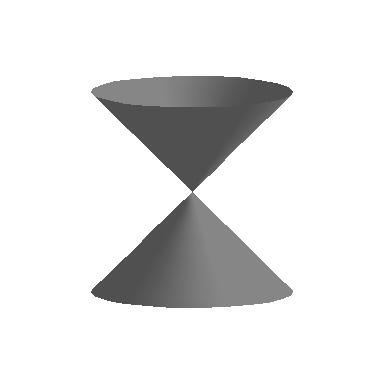
PreCalculusIn this chapter, we study the Conic Sections - literally ‘sections of a cone’. Imagine a double-napped cone as seen below being ‘sliced’ by a plane. (The following interactive by Juan Carlos Ponce Campuzano is useful.)
If we slice the cone with a horizontal plane the resulting curve is a circle.
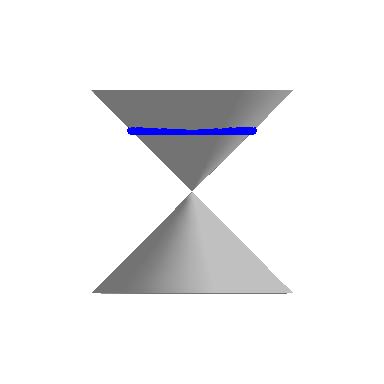 | 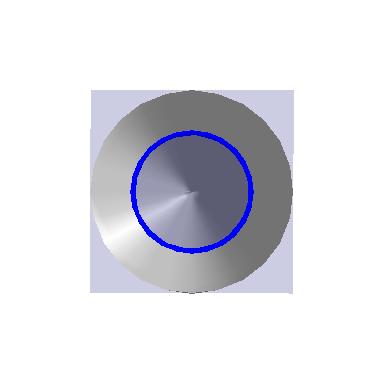 |
Tilting the plane ever so slightly produces an ellipse.
 |  |
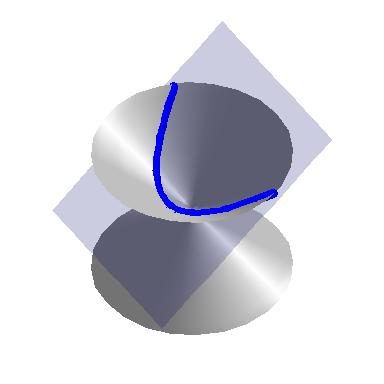
If the plane cuts parallel to the cone, we get a parabola.
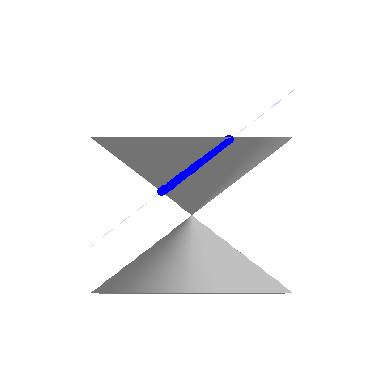 |  |
If we slice the cone with a vertical plane, we get a hyperbola.
 |  |
If the slicing plane contains the vertex of the cone, we get the so-called ‘degenerate’ conics: a point, a line, or two intersecting lines.
 |
 |
 |
 |
 |  |
While this geometric introduction to the conic sections has its uses, in order to study the applications of the conic sections, we require a more analytic approach. It turns out each of the of the conic sections can be described as as a locus of points - that is, a set of points which satisfy a certain condition involving distance. The reader is referred to Section AppCartesianPlane for a review of the distance and related formulas.
As we’ll see, we’ll be able to use the distance formula to algebraically represent the conic sections as graphs of general quadratic equations in two variables. That is, every conic section in the \(xy\)-plane can be represented as the graph of an equation of the form \(Ax^2+Bxy+Cy^2+Dx+Ey +F = 0\) for real numbers \(A\), \(B\), \(C\), \(D\), \(E\), and \(F\).